Friday, September 3, 2010

Day 13: I'll Be Comin' Through The Mountain When I Come

Day 13:


Today was Carpathian Mountains Day. In fact, we were scheduled to go over what I am told is the highest mountain in the Carpathian range (which makes it the highest mountain in Romania) because that is, unaccountably, where the Romanians decided to make the road over the mountains. The day dawned cold but clear, a big change from the rain we'd had the last couple days. We all piled into the Dacia in high spirits and prayed there wouldn't be snow on the road. To the left you'll see Emma doing her best Cee-Lo impression as she belts out "Crazy" for the rest of us.


A short way up the road, we ran into our first obstacle. Although snow-colored, these sheep fortunately posed little danger to our trusty Dacia. After a short delay, we were back in business.


It got much, much colder the higher we got. Emma and I bought gloves at a roadside stand. The cloud and fog layer started coming closer and closer to us.

I tried to get some photos showing how steep the drop-off was, but it just doesn't come out in pictures. Sometimes it's fine, but there are lots of stretches where the cliff is nearly 90 degrees. You walk up to the edge and look down and it's like looking over the roof of the Empire State Building.


About an hour or so in, we were above the snow-line. The bright sun of Versailles was far, far behind us. The roads at this point were slushy with some snow, but the Dacia -- loaded down with all four of us, our luggage, and towels -- handled it just fine.

Keep in mind, by the way, that it's just a week outside of summer at this point, but there's a bunch of snow on the ground up here. Io said the highest parts of the mountains have snow essentially year-round, with maybe one month of melt.


Further up, and the snow is higher. They don't have an actual snowplow, but the Romanians keep the road clear by driving a back-hoe down the road with the front shovel blade lowered, clearing out a single lane that sort of wanders over the road.

This was definitely challenging to our doughty driver, Gagi. But he handled it like a champion.

The mountains themselves were really gorgeous:


As the road got closer to the top of the range, the Romanian engineers apparently looked back at the miles and miles of snowy switchbacks and collectively decided "Fuck this" and blasted a tunnel through to the other side. Let me just tell you all right now: do not cross the Carpathians if you're claustrophobic. The tunnel was quite long, completely unlit, and curved enough so that for about a third of it you're in total darkness.


Once out the other side, we started heading down again and ran into yet another herd of sheep. That shepherd has got some real stones herding sheep this high up. I mean, I was freezing just looking at him.


The snow thinned out again as we headed lower, which was a happy thing for all of us. Eventually we made it down to a little town on the other side.


I think of this place as Rachel-town, because they had horses that just wandered around wherever they felt like. We stopped for some tea and hot chocolate and then pressed onwards.


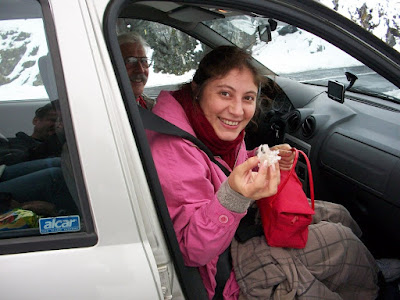
Unfortunately, Ioana got a pretty bad cold starting on Day 13. She stayed in the car bundled up almost the entire time. The only time she really got out was for the horses. She maintained her good cheer, though:


We drove for quite a while down the mountain, passing an old Romanian fortress on the way. Io told me we'd be climbing up to that fortress tomorrow, which involved going up 1,500 steps. I figured I had better eat well for lunch, dinner, and breakfast tomorrow, and probably for the two or three days after the climb just to be sure. When we stopped to eat I got a traditional Romanian stew with pork and sausage, polenta and fried egg. Io got an entire fish with a head on and everything.


Fish With Heads Still On: Yuck

We stopped for the night in a great little place where we all got our own rooms, which even had showers with hot water and actual water pressure. I had my first good shower since I got here, which as you can see by looking at the title of this post was two weeks ago. Yay!

Wednesday, September 1, 2010

Day 12: L'etat, C'est moi

Day 12:

After a lovely and freezing night's rest, we all got up this morning with the same question in mind: What should we do today? We were at a Crossroads of Life: we could head to our next destination, which is up high in the Carpathian Mountains; or we could go see Sibiu. But seeing Sibiu would mean staying another night at Versailles, because Gagi will only drive the Carpathian road if we get an early start.

I was voting for Sibiu, because I am really digging Versailles and would like to spend another night here. After a hearty breakfast of fried mamaliga, farm-fresh eggs, sausage, and mici, we decided to go see Sibiu. After driving 10 minutes towards Sibiu, we decided not to see Sibiu after all. Gagi pointed out that we were passing another village museum, which he said would be good to see. But it would mean missing Sibiu because it would take all day. Fine with me! So we pulled off the road and went there.


It was along the same lines as the village museum in Bucharest: original construction buildings and other items, transplanted to this museum from all over the country. But it was a lot bigger than the one in Bucharest, and it included things from a much larger timespan. Bucharest's museum was basically all medieval. This one spanned from Dacian (pre-Roman) times all the way up to just before the Industrial Revolution.


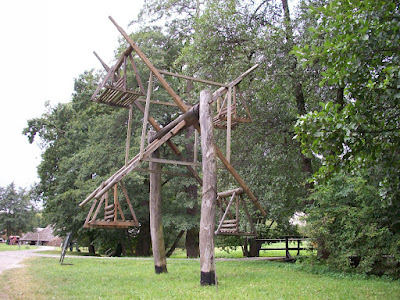
This was one of the oldest things I saw there. It's a Roman-era oil-press. You put sunflower seeds in the little well in the middle, set the large T-shaped piece on top, and then use the gigantic hanging hammers on either side to pound one wedge after another into the machine, pressing the T down onto the seeds to get oil.

*Correction: Io informs me that although this is the same technology used by the Romans, this is not actually from Roman times. Which makes sense, if I had stopped to think about it...it's made of wood.


This tractor was probably the most modern thing I saw there.


Chris Pulliam, do you know what this is?


Medieval bowling alley!


Sprinkled throughout the museum are these history buffs. They're all retirees, living on their pensions, who spend their twilight years hanging around the museum and telling people about whatever their area of interest is. They get a small stipend from the town for that, and I think it's typical to give them a tip if you're happy with the information they give you. This guy was a specialist in oil pressing. He's the one who explained the Roman oil-press to me, as well as various other ones from other periods in history. You might think that oil-pressing is pretty dull -- that was certainly my first reaction -- but it's actually really interesting to see how any particular industry progressed as technology improved. We got to see, live and in person, how things evolved from the Roman wedges-and-giant-hammers method up through foot-powered machines, stone wheels, metal screw-presses, and so on.


We walked around a whole huge area looking at buildings and reading signs. After a couple hours of walking, Gagi said we saw maybe 10% of the place. That's a pretty big museum.


Ancient house-boat


Medieval Ferris wheel


Water mill. +1 hammer +1 coin on river tiles.


Hand-operated grain mill. The user would crank the stone around by arm power, and flour would trickle out the notch in the wood.


+1 food +1 coin on hills. OK, I will stop doing that now.


This museum building is on the Romanian 10-lei note.


We had lunch at the restaurant attached to the village museum: schnitzel and potatoes for me (Transylvania has a lot of German history and influence -- most signs and menus are at least in Romanian and German up here), followed by a Transylvanian version of donuts called (I think) papagosh. They were basically donuts with sour cream and strawberry jam. So good.

We then got back into the Dacia and took a little tour of the countryside. Romania is an almost schizophrenic country. The large cities, particularly Bucharest, are pretty advanced. Bucharest has lots of large buildings, enough cars to create massive traffic-jams during rush hour, as well as a fully developed public transportation system including subways, light rail, buses, and trolley cars. You can buy top-of-the-line electronics there; in fact, I saw my first functioning home-3D system at a Domo Electronics store in the Auchan hipermart.


But once you get out into the countryside, the advancement level drops off a cliff. By the time we were a couple of hours outside Bucharest we were passing people in horse-drawn wagons all the time. I've probably seen 50 or 75 people driving wagons since I landed.

Romania is a country where people routinely talk about "the peasants." You've got the people who live in the city, who live lives that seem about 85% similar to the sort of life I lead in Los Angeles, and then you've got the peasants, who live in the countryside in a bizarre world that is 70% the same as the way people lived 500 years ago. I could put up dozens of photographs of these peasant shacks just sitting out in the middle of nowhere. When you first go to these village museums you think "Wow, I can't believe they were able to find all these intact medieval buildings," but after spending some time in the Romanian countryside, you realize these things are actually pretty common. And people live their lives in them, just as dozens of generations before them did.


There are some changes -- most of the wagons have rubber tires, for example, and several of the peasant villages have electricity -- but as far as I can tell the vast majority of their lives is the same as it was before the Renaissance. People herd cows and sheep, they plant and harvest crops by hand, draw water up from wells, and so on.


One of the issues facing Romania since its inclusion in the EU is that the EU has moderately strict food regulation, similar to what we have in the US. But so many Romanian peasants make their living selling unpasteurized milk, cheese, and eggs, and unregulated meat and skins and other animal products, that it's nearly impossible for the government to start telling everyone they have to follow such-and-such procedures and allow their work practices to be regularly inspected and regulated.


It's going to be interesting to see how the country deals with these issues as they move forward.

After the countryside tour, we came back home and have spent the entire night playing pool and ping-pong against each other. I won every single game I played. At least, that's how I remember it.


Tomorrow we're saying "Au revoir" to Versailles and heading off to the Carpathian mountains. I'm told there is 5cm of snow on the roads, and that route over the mountain is full of switchbacks and areas where there is nothing but deadly cliffs on either side. So this may well be the last anybody ever hears of me.


Day 11: Medieval Europe and Renaissance France

Day 11:

We spent the night in what is essentially a hostel, sleeping all four of us to a room. You might be thinking "Wow, what a terrible honeymoon," but consider that our first honeymoon was spent in 115 degree heat and I was attacked by scorpions. In context, this was actually pretty great. Once we were all up and ready to go, we headed back out to Sigisoara to tour the place in the daytime.

We spent a lot of time just ambling around the city. It was a great place for souvenirs, and for sightseeing. I managed to order myself a snack in Romanian all by myself again, although when it got to asking for a pastry I just had to say "si este" ("and this") while pointing.


In the middle of the city, in the Clockmakers' Tower (I think), there's a big history museum. It's I think six or seven floors (although each floor not that big -- it's the tower), and wow was it awesome. They had tons of artifacts from medieval Romania, just room after room of really cool stuff: tools, machines, furniture, signs, you name it. Then going back further, they had stuff from all the way back to the Second and Third Centuries, when the Romans ruled the hill and built a fortress there. There were old Roman coins, bits of tools and weapons, lots of neat things. And it went back even farther than that, because they had artifacts from the Dacians -- the pre-Roman civilization that lived in the area all the way back to the beginning of the Bronze Age. There were axe-heads and coins and lots of pottery that survived. Some of the pottery was really amazing, especially considering the primitive conditions under which it was made. It looked like stuff you would pay a lot of money for at Restoration Hardware or Williams-Sonoma.


We toured around the city some more, and in the afternoon piled back into the Dacia to head out.


Our next destination: Sibiu. Sibiu is another old, old Romanian city, much larger than Sigisoara but not as well preserved -- it's more like Bucharest, a modern cosmopolitan place but with some medieval buildings still around.

The trip to Sibiu was pretty uneventful, and only a couple of hours. After we got there, though, we spent over an hour looking for a place to stay. Gagi said that there were lots of "pensiunea" (bed & breakfasts) in the area, and we would just drive around until we found a good one. But the best values were outside of town, because Sibiu is a big tourism destination and many people get there by train or airplane -- so the B&Bs in the city are really expensive, but the ones that are driving distance away are a lot cheaper.

Gagi and Io went to check each place that we stopped. Em and I had to stay in the car because if the owners realized we were Americans suddenly the rates would double. The first place we checked, they said was pretty good, and 200 lei per night (about $60) for the four of us in one room. That was the top end of our budget. It was basically a small house on a dirt road shoulder-to-shoulder with other houses. But the owners kept chickens, and the whole place smelled like chicken-shit, so Gagi and Io decided to move on. The next place was a bit cheaper and a bit bigger, but the owners apparently kept rotting corpses in the basement, because Io said she was nearly throwing up the entire time they were there.

The third place we checked was this one in the photo to the left. Gagi and Io went up to talk to them, and I was sitting in the car with Em going "What are they thinking? This place is a palace. It's huge. It has a gazebo, for Christ's sake. Is that a tennis court? What on earth makes them think this is going to be less than the chickenshit house? It's like the hovel was too expensive, so we're all 'Well, maybe we could stay at Versailles.'"

But it turned out that Versailles offered us two rooms (a triple and a single) for the same 200 lei that the chickenshit place wanted. So Versailles it is!

Versailles is pretty sweet, as it turns out, with a game room, an outdoor barbecue, a combination tennis and basketball court, and a giant kitchen where we can cook food for ourselves so we don't have to go out. It's a little sad, actually -- the place has twelve rooms and a dining room that could sit 25 people with ease, and the first day it was just us and one other family; the second day it's just us alone. The proprietor is jumping through all sorts of hoops to make sure we're kept happy. The lousy economy has apparently taken a major toll on the tourism industry in general and this area in particular.


We had a lovely dinner of barbecued mici and sausage, and mamaliga (polenta with cheese and sour cream), and then all piled into our rooms to go to sleep. It's freezing cold (we're up in the mountains a bit) and there's essentially no hot water, but we're having a blast anyway. Tomorrow it's sightseeing and then we'll see what we want to do.


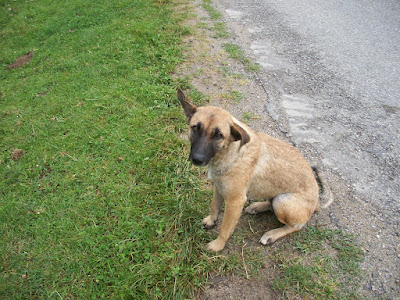
My favorite of the many dogs at Versailles. For some reason, her name is Mrs. Waffles.
I've just learned that all the photos on this blog are stored on Picasa at much better resolution (1600 x 1200). You should be able to see larger versions of all the photos here:


For reasons I don't understand, some of the photos are duplicated (Mal is in there like twenty times). But if you are looking at any photos in the blog and want to see them larger and in more detail, there's the place to go. I don't know why the blog doesn't just hotlink them, but whatever. Enjoy!